Unknown's avatar

About Brandrenaline, Inc.

Adrenaline for your brand. Motorsports, sports marketing, sponsorship, strategic planning, corporate restructuring... branding.

An Open Letter to IZOD IndyCar CEO – Randy Bernard

** I originally published this blog story in August of 2010 – nothing has really changed. **

An open letter to Randy Bernard – IZOD IndyCar Series CEO

So you’ve been handed this box full of puzzle pieces and you been tasked with putting it back together. There might be a few people that hope that you fail, but they have a personal agenda, and I am not one of them. I hope that you make the cover of Time magazine – twice.

I am going to be the next – but not the last – in a long line of super-duper experts on the topic who will offer some insights into the challenge that you have accepted.

Let’s start with those experts. Already – and I am speaking metaphorically here – you have been in the presence of two seemingly sane, professional, accomplished, well-regarded stakeholders who are on the complete opposite sides of an issue or solution to a problem. So who do you listen to? Oh sure, you take in both sides of the issue and go with your gut. That has always worked. But frankly, you can’t afford to be wrong. Let me use a completely different scenario to illustrate my point. You have this tree in your front yard and it is oozing ‘stuff’. You call two tree experts to give you their diagnosis of the problem. Expert 1 says that the tree must be cut down and removed. Expert 2 says that he can treat the affected area and it will be fine. Who do you listen to? With all due respect, you are not qualified to know which one of them is right. You have the same problem in your role now. Who do you listen to? Ask five people in your paddock and you’ll get five answers. So, who do you listen to, and… what the heck is the question anyway? I think the questions are; What is your goal? And… What is the problem? These need to be answered before any solution can be applied. Getting everyone to agree on those answers is near impossible, but this is my letter to you – so these are my answers…

What is your goal?

I am going to assume – because I do not know – that your goal is to make the IndyCar Series a professional sports property that is supported by a “large audience”. And “supported” means in-person, and through media (TV, radio, www etc). So measurement, for the purposes of this exercise is “large audience” – period. It’s not the coolest cars, longest straightaways, highest speed, greatest dancer, biggest tires, sexiest driver…. It’s “large audience”.

I choose “large audience” for a couple of reasons. First, nothing that you are doing matters if nobody cares. It’s not about close finishes – USAC Midgets and go-karts have some of the best “racing” you’ll ever see. But nobody (except Robin Miller) cares. You need audience. And second, and this is key: Audience = Value. Over the past 15 years, I have had literally hundreds of racers, team managers and team owners say to me “I need a sponsor”… and my response for the past 15 years has always been the same. “No you don’t need sponsors… you need value. Find value and the sponsors will come….” Approximately – give or take – 100% of those people walked away shaking their head and mumbling that I didn’t know what the hell I was talking about.

What is the problem?

So, the goal is ‘large audience’. That’s what you need Randy. But, what is the problem? Let’s examine other success stories in properties that have ‘large audiences’. There are some very simple lessons learned from the Olympics, the NFL, the World Cup and American Idol. And it’s simple really, when you step back and look at the key ingredients. There’s only three, and here they are Randy:

1) The audience needs to be able to relate to the talent of the athletes.

2) There has to be something significant on the line. In other words, the ‘prize’ for winning has to be substantial.

3) You need to have the very best competing at your events.

That’s it. Don’t believe me? Just remove, reduce or diminish any one of the three and see what you have. When you have these three things in place, everything else follows. Everything. Audience, sponsors, TV, merchandise sales, the best team owners, the best athletes, the best crews, the best talent… everything.

Below are my “success triangle” illustrations to make my point. To oversimplify, “Success” is a triangle consisting of the three elements above. Your goal is to have a big triangle. The bigger the triangle, the more successful you are. Again, simple. And the triangle, as a shape is perfect because the size of your success triangle will be restricted to your weakest element. Have a look at these illustrations:
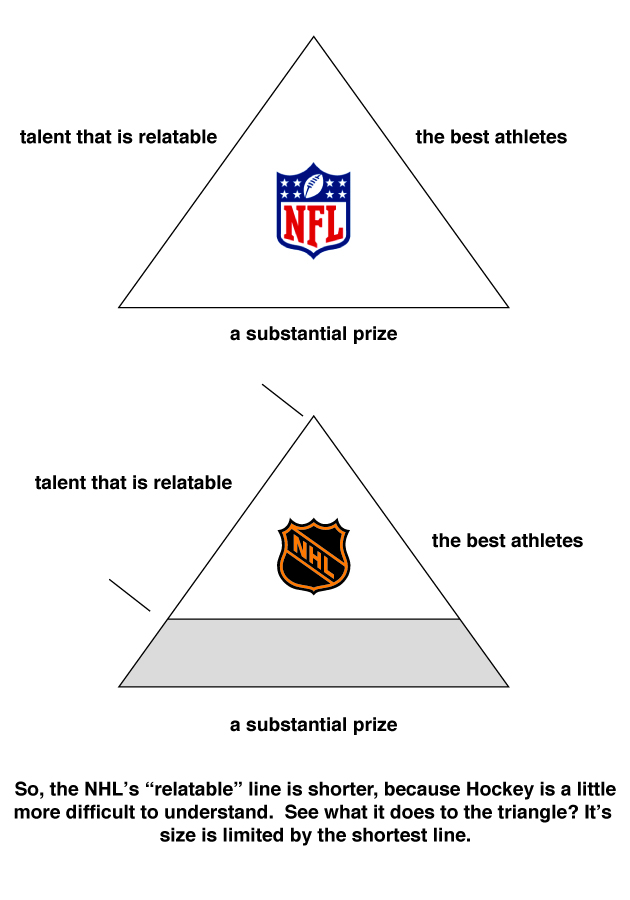
So, that’s the problem Randy. The IndyCar success triangle has some short, weak, flimsy sides.

Okay… still skeptical. Let me prove it. And we’ll do each ‘ingredient’ – one at a time.

1) The audience needs to be able to relate to the talent of the athletes.

I am going to give you examples of properties where this is missing, relatively speaking, and I’ll give you examples of properties where this exists.

Let’s start with the Big 4 mainstream sports properties in North America. The NFL, NBA, MLB and NHL. Remember, the audience needs to be able to relate to the talent of the athletes. Which of these sports has the ‘largest audience’? That would be the NFL. Which has the smallest? The NHL right? From the mind of the audience, which sport is easier to understand, and why? Here’s the NFL; two 350 pound guys, who can run really fast, smash into each other. It’s like the Flintstones meets NASCAR. The audience can see this and understand what is happening. A wide receiver completely stretched out to catch a pass with one hand is easy to appreciate – even if you have never seen football before in your life. This is really important. In the NHL, the audience is able to understand the athletes ‘better’ if they’ve played hockey themselves. If you take the same person and expose them to football and hockey, they will grasp football first. This is how you grow audience. By having the ability to relate to the talent of your athletes. And no matter what the NHL does to try to explain ‘offside’, they will always be limited by this. In your sport Randy, the challenge is that unless you’ve driven a race car, it is hard to “see” Will Power’s talent and relate to it. To the masses – the general public – Will looks the same as Danica going through any given corner. But there is clearly a difference in talent that is hard to appreciate. In fact, speaking of talent, what is Danica’s talent compared to Sebastien Bourdais? Both are clearly extremely talented, but they are talented at two completely different things. Which ‘talent’ will drive your growth? To have mass appeal, you need the best athletes, and the masses have to be able to relate to their talent. This is a big challenge, and that is putting it lightly. Cricket is an incredible, global, professional sport, but I don’t follow it. I can’t relate to the talent of the athletes. I just don’t get it.

2) There has to be something significant on the line. In other words, the ‘prize’ for winning has to be substantial.

Randy, this ingredient is key because the audience wants to know that there is something on the line. A monumental prize for the winner, and significant lost opportunity for the loser. The audience needs jubilation driven not just by financial gain, but by the prestige of winning, and they need heartache and disappointment. They need to see success and failure at the highest level. This is why your Indy 500 means more than the Iowa race – whatever it is called. And this is why the 6:00pm news is so popular. People think that “Reality TV” is relatively new. They are misguided. “Reality” programming such as the newspaper or TV news broadcasts have always been around. Reality TV was borne from the audiences’ desire to see winners and losers, pain, sorrow and occasionally – joy. When the audience’s appetite wasn’t fulfilled from 6:00pm-7:00pm, the networks created their own misery – Reality TV. Ted Turner, of course, recognized this many years ago and created CNN.

Back to my point Randy; The Stanley Cup, the Super Bowl, an Olympic Gold Medal, the World Series, The Indy 500, the Daytona 500, the Monaco Grand Prix, the Kentucky Derby, the Masters, the 24 Hours of Le Mans. These ‘prizes’ transcend these sports. Audiences that have no interest in the ‘sport’ come from far and wide to experience these events. Why? Because there is a significant prize on the line. If the prize for winning American Idol was a three-night gig at the Holiday Inn in Brownsburg, Indiana, who would watch? Take the same talent – talent that the audience can relate to – and change the prize. Simple. Motorcycle racing in the US is a great example of what happens when you take away the prize. It’s dead. The Daytona 200 used to mean something. They took away the prize and they excluded the best athletes…. and you can stick a fork in motorcycle road racing. But I digress.

3) You need to have the very best competing at your events.

Okay Randy, this one is real ball-buster. I say that because as long as there has been motorized competition, there have been “fast guys, rich guys and idiots” (thanks Sam Moses). But nonetheless, as I have stated above, and as history has proven, if you do not have the very best in your ‘competition’, you will fail – always. How many players in the NFL ‘bought’ their roster spot. Randy, I know you have heard this analogy many times before, but if Mark Cuban had bought the Dallas Mavericks and inserted himself into the line-up, the audience would disappear. Not at first, because remember, we love failure, pain and misery, and we need to be able to relate to the athletes. But in this case, it is not sustainable. You want more proof? Look at the Grand Am Rolex Series. What a can of worms they are in. Without their ‘gentlemen racers’, they would not exist. You should thank your lucky stars that you have not been charged with growing their audience. Ride-buyers and other ‘drivers’ who have no business being on the track, while the real talent sits on the sidelines, won’t work. Here is the other problem with this, and this is also very critical. As soon as a driver, or a team owner, reaches into their pocket to participate in your series – you work for them. Period. Do you want to work for Chip? Or do you want to work for your audience? Which ‘boss’ offers long-term stability? When your property has not provided enough ‘audience’ to build a profitable value proposition, you’re in trouble. I don’t care that “it’s always been like this”. What I care about is that it won’t work. So, if your going to head down the path of allowing ride-buyers, you need to change your positioning. You’re not a professional sport. You’re a platform that allows talent-less people to “live their dream”. You’ll need some branding/marketing agency to help with the positioning on that. Maybe Gene Simmons of KISS. Does your audience understand why Milka is racing and Bourdais is not?

So there you have it. I am fully aware that I have not offered any real solutions here. But, until somebody points out what the problem really is, anything you do is either short-term or irrelevant. If a new car is the answer, then you need a new car – all the time. If splitting one race into two is the answer…. cool, but that is change for change’s sake, and you need your next 10 changes lined up and ready to go.

So, my letter to you Randy is to tell you what the problem is.

There are great lessons to be learned all around us. Like American Idol. I love American Idol because of the beauty and simplicity of the show as a marketing communications platform. What is the difference between Carrie Underwood before and after appearing on American Idol? It’s not talent – she had that. Sure they massaged it, but she had talent. She’s one of the world’s best. The only difference between Carrie before and after is…. audience. That’s the only difference. But this isn’t just any ordinary audience. American Idol’s audience is 30 million strong – the world’s largest focus group. Every week they tune in and answer the question that American Idol is really asking. That question is, of course, “Which one of these 80,000 contestants’ album who you buy?” Again…. so simple. Every week, the focus group answers that question and when the record comes out, they already have…. audience. The producers of American Idol aren’t in the TV business – they’re in the music business. And Ford and AT&T fund their search for new talent. Think about that and explain how a new car can do this for you. And think about your focus group Randy. Who are they? Where are they? What do they want?

So that’s it. You need the best athletes in the world. They need to be relatable and you need to have the big prize. Do this and history has proven that you’ll have audience. And audience Randy… equals value.

Move fast Randy… be careful who you listen to… and good luck. I am pulling for you. I really am.

BMW Williams F1 Test at Silverstone – September 2005

This blog story will cover topics such as English bird poop, world-class amplification, the BMW Williams F1 factory and some F1 testing stuff. Enjoy!

Back in September, 2005 while I was Series Manager for Formula BMW USA, we were invited by the BMW Williams F1 team to attend an F1 test session at Silverstone. So, we sent invites to all of the competitors in FB USA at the time (26). We told the parents that three of us from the series management would escort the drivers and it would be a great experience.

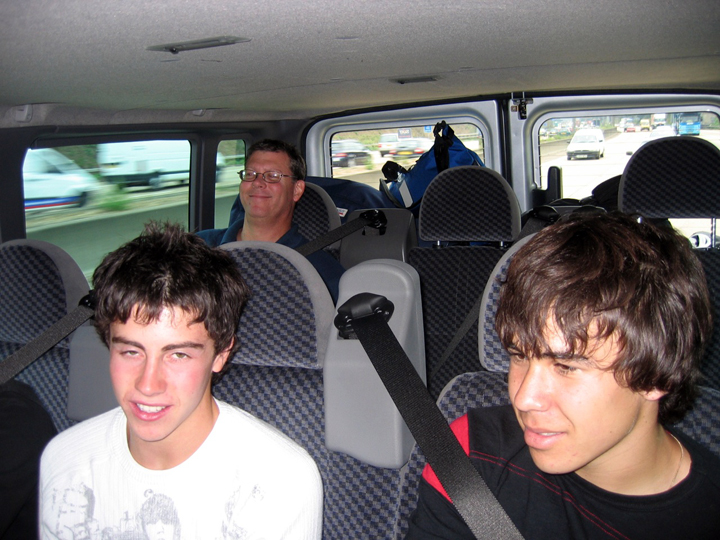
Michele Henn, who really did all of the work at FB USA, Clay Filson, who headed up all things technical in the series, and myself would take some teenagers over to the UK. Sounds fun!… and it was. Three of our drivers agreed to go. They were Robert Wickens (twitter @robertwickens), James Davison (twitter @JDDavison21) and Reed Stevens. Reed, at 18 was the oldest. Robbie was 16 and I think James was 17.

We all met at New York’s LaGuardia… and off we went.

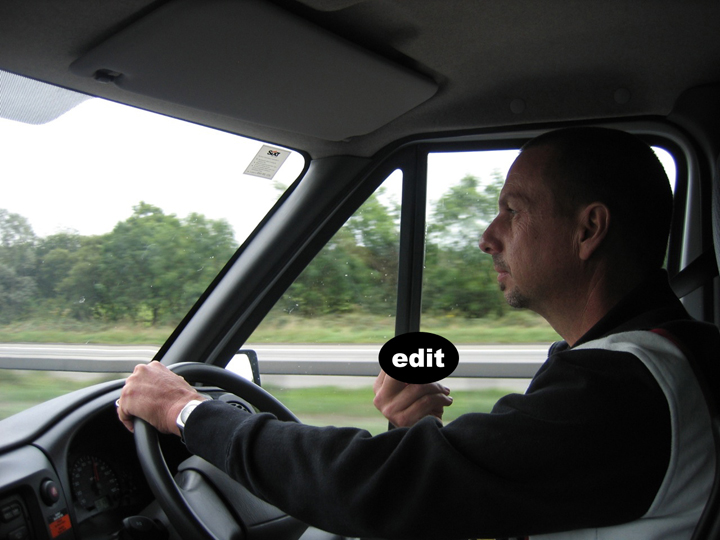
Strong navigation would be critical to a successful trip. Driving on the wrong side of the road is always a challenge.

We were told to change our priorities and then to give way as we exited Gatwick.

We had several months to plan this trip and when Michele – who is a top-shelf navigator – casually mentioned the words “Milton Keynes” as one of the towns we’d be passing through, I got very excited. Not because of the race teams that are based there (this is where the Red Bull F1 team is based today), and not because of the thriving cottage industry of fab shops who support racing that are based there. It is because Milton Keynes is home to Marshall Amplification. So Michele made sure that we included a visit to Marshall’s HQ in our itinerary.

Not a good time to bother the driver as the driver is getting accustomed to wrong-sided driving. “Strong Navigation!… please.”

I felt that this trip was all about education for our young drivers and what better time than now to learn about where Angus Young, Ted Nugent, Slash, Eric Johnson and Ace Frehley – too name just a few – get their sound? So, once we left Gatwick and got our bearings – but before we even got to our hotel – we went to Marshall.

I am livin’ the dream right here….


I asked if Jim Marshall was in. He was not. Bummer. But the lobby was fantastic. I just stood there in awe thinking about how this facility had turned some wood, wires, knobs and tubes into life-changing culture-forming unforgettable sound. James, Reed and Robbie were unanimous in what they thought of visiting Marshall Amplification. It made them all hungry and they wanted to go eat. They were clearly affected.

Clay knew how excited I was to be there and after we had all loaded back into our rental, he actually went back in to the office and got some free swag. Pins, key chains, and a great CD of music pushed through Marshall amps. Brilliant!

We took some time to stroll around Milton Keynes, found some food, and enjoyed the culture and great weather.

Reed Stevens taking in the UK way…. note the sign above his head.

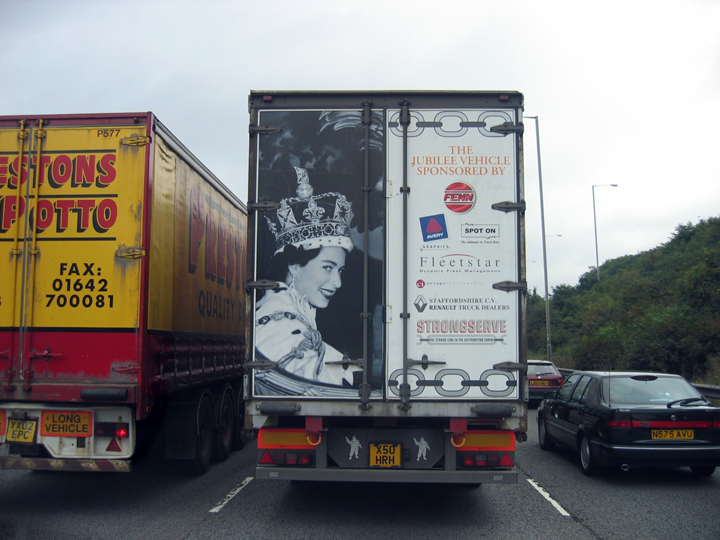
Then we loaded up and headed towards Grove – home of the BMW Williams F1 team. We did encounter some traffic and even got to see the Queen (her majesty), Queen (the band) and the Beatles emblazoned on various vehicles touring the motorways. How royal is that?

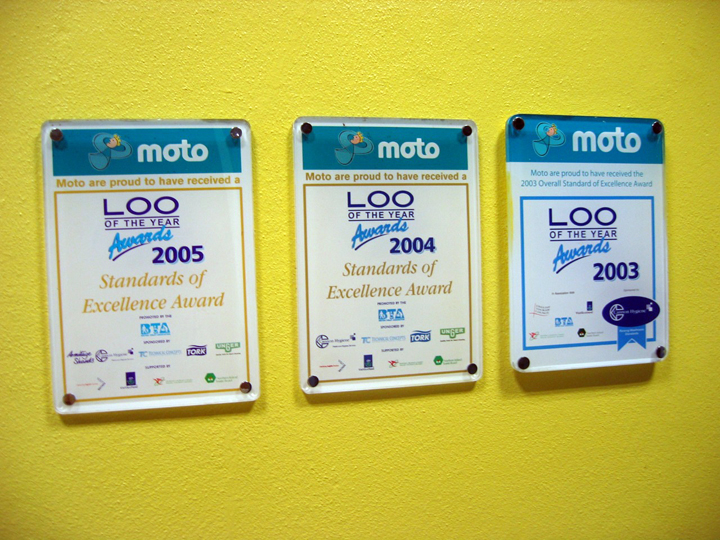
We stopped at a service center along the way and what are the odds that where we would stop to stretch, snack and use the restrooms, would happen to be at the facility that has been awarded “Loo of the Year” for three straight years! This was shaping up to be one heck of a trip.

We actually ‘used’ the 2003, 2004 & 2005 “Loo of the Year”. This would make a trip complete on its own – but there was more to come.

James (front left), Robbie (front right) and Clay (getting mentally prepared)

We checked in to our hotel and were excited about tomorrow and our visit to the BMW Williams F1 factory and conference center.

Day 2.

Today we would visit the BMW Williams F1 factory and the Williams Conference Center. We would be treated to a private tour by none other than Jonathan Williams. Jonathan is the son of Sir Frank Williams, CBE, who founded Frank Williams Race Cars in 1966. Ayrton Senna, Nigel Mansell, Alain Prost, Jacques Villeneuve and Keke Rosberg to name just a very few, have all driven for Williams.

Jonathan met us in the lobby of the factory and after introductions, led us on the 100 or so meter walk to the Williams Conference Center – where our tour would begin.

None of us actually saw it happen. And it could have easily happened to any one of us. But it happened to be Jonathan’s time. You see, the walk from the factory to the conference center is outside. The wind tunnel was on our right. The ‘world’s fastest shrubbery’ was on our left. The rare-for-the-UK blue sky had at least one bird flying above. And so it happened.

Jonathan Williams got pooped on.

Not only did none of us see it happen, but Jonathan didn’t feel it either. This, in hindsight, was extremely odd given the mass and composition of the poop.

Jonathan Williams in the light blue – but soiled – dress shirt, starts our tour in the lobby.

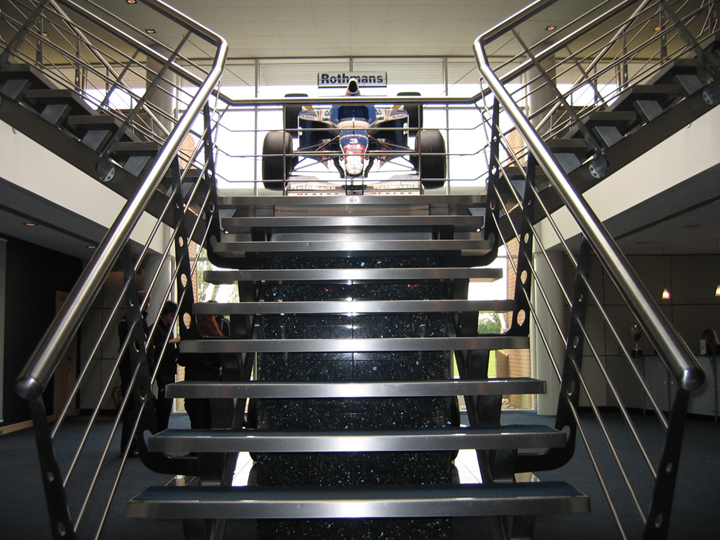
Jonathan started our tour in the lobby. After a quick look at a showcar featuring the current livery, we headed down the hall towards the Alan Jones Room. And that’s when we saw it. The UK bird poop. The three – and I use the term loosely – adults, immediately felt horrified for Jonathan. The three – and I use the term literally – teenagers, were giggling.
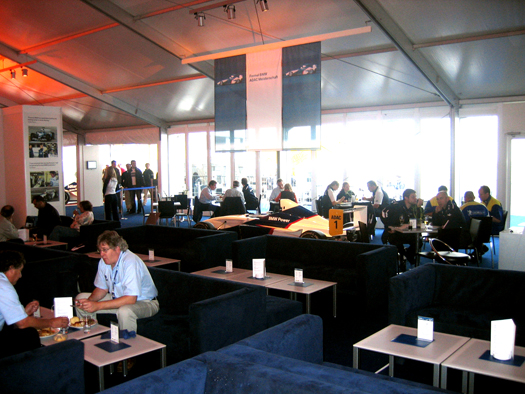
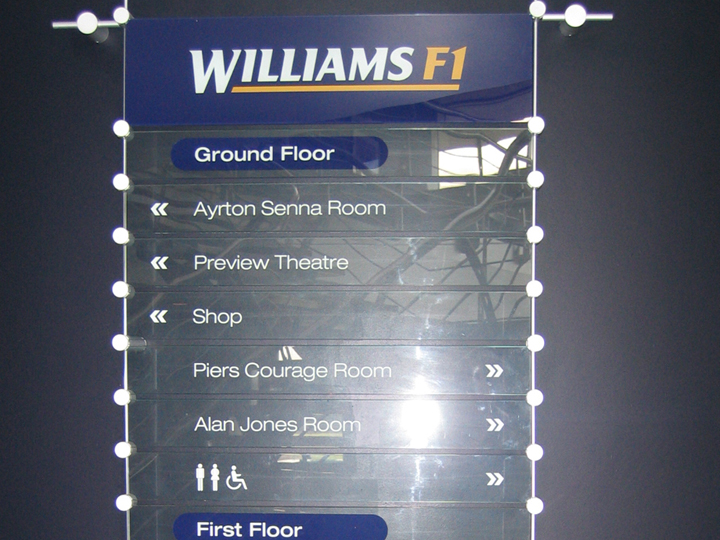
The “Alan Jones Room”. Is there one bottle out of place? I think not.

Sometimes being the Series Manager means that you have do those things that no else wants to do. So, I separated Jonathan from the giggling future Williams F1 wanna-be drivers, and told him that he’d been hit. His first reaction was to reach for it. To confirm its existence. It’s a natural reaction. I grabbed his wrist in mid-flight like a Kung-Fu master blocking a lethal blow. “You don’t want to touch that”, I explained and I eased him towards the rest room.

Jonathan emerged about 10 minutes later, sporting a new team fleece, and continued the tour as though nothing had happened. We all learned a lesson from Jonathan who is a class act. That lesson – Shit happens and you just carry on.

The Williams Conference Center has one of the world’s greatest collections of race cars and Jonathan knew the history of each and every one. Standing amongst this Championship-pedigree and learning some real behind-the-scenes detail was an extraordinary experience. One we’ll never forget.

Jonathan sporting a new team fleece.


We saw the trophy room, the theater, the Hall of Champions and much more.

Spectacular, and now, time to head back to the factory. No photographs are allowed in the factory. As you’d imagine, it was clean, organized and was operating with coordinated precision. The exhaust systems for these BMW engines are still made entirely by hand and we all got to feel how feather-light they were. An engine fired up in main service bays. BMW staffers are always on hand when an engine is fired. In fact, the engines won’t start without them plugging in their computer to allow it. Cars and equipment were being loaded for the next race event, and another completely separate, dedicated team of engineers, mechanics, aerodynamicists and other specialists – including drivers – were prepping for the Silverstone test day.

We couldn’t wait for that. That was why we were here.

One more kinda unusual thing happened while at the BMW Williams factory, and I apologize as my recollection of the details are foggy. Somehow, for some reason, James Davison ended up on the ground doing push-ups. There is no doubt that if James could do 300–400 push-ups, Jonathan Williams would instantly hire him to drive their F1 car. No doubt. But unfortunately, that wasn’t what happened. What happened was that James hurt his upper back/neck area.

He couldn’t move his head.

So, Jonathan calmly picked up the phone, called the team’s chiropractor and ordered immediate service for young James. Within minutes, we were following Jonathan into Grove and then sitting in the lobby of the “Official Chiropractor of the BMW Williams F1 Team”.

James got semi-sorted and as we reflected on an incredible day, we also couldn’t wait for the upcoming test session at Silverstone.

Day 3.

Today we would attend the BMW Williams F1 test at Silverstone. We would be treated to a private test and our host was Jonathan Williams, son of Sir Frank Williams, CBE, who founded Frank Williams Race Cars in 1966.

left to right; Reed Stevens, Robert Wickens, James Davison

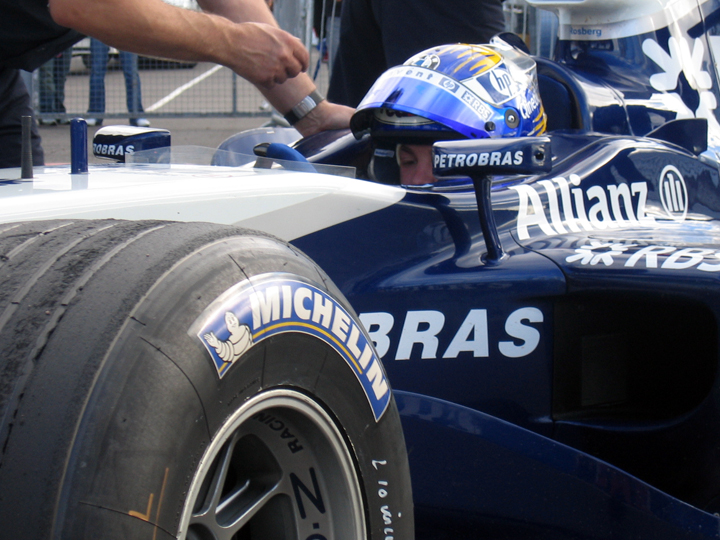
The drivers that were testing on this damp and then sunny, and then damp, and then sunny day were Nico Rosberg (@nico_rosberg) and Antonio Pizzonia (@AntonioPizzonia).

Nico is now driving for Mercedes alongside (or in front of) Michael Schumacher, and Antonio is racing mostly in his home country of Brazil.

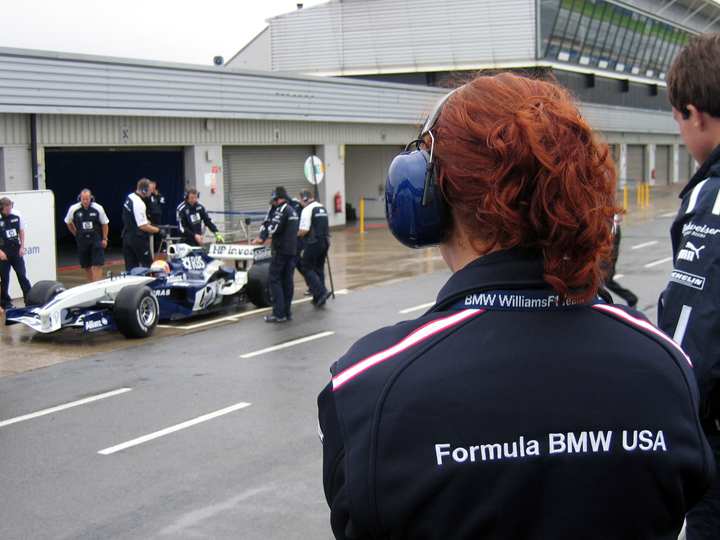
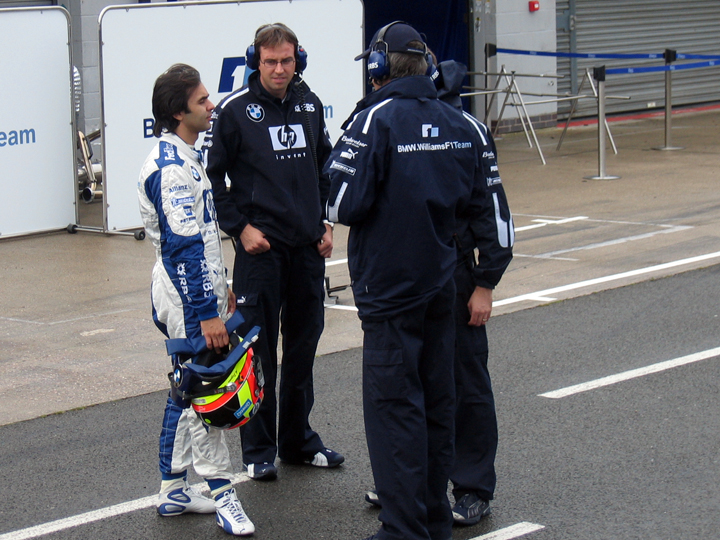
Jonathan set us up with headsets so that we could hear the interaction between the engineers and the drivers. Our agenda was that we would start out in pit lane and take that in for a while, then Jonathan would take us to some of the great corners that make up this historic track. Copse, Maggotts, Becketts, Stowe and Club, to name a few. After that, we would do lunch with Pizzonia and then go back to pit lane for the remainder of the test.

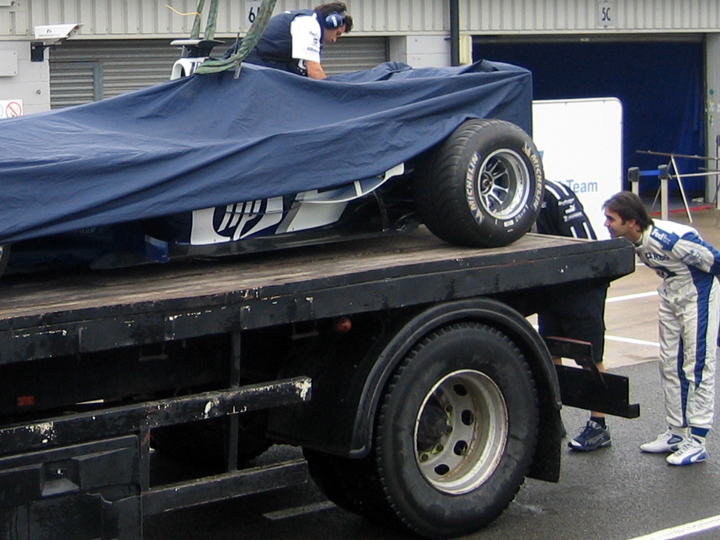
Of course, it was all very interesting stuff. Pizzonia had an incident and even though it was a private test, they covered his car up to bring it in. “Private” might be the wrong word, as the Panasonic Toyota Team and Ralf Schumacher were also there. And the Williams marketing department did have some sponsor guests, although they didn’t get near the access that we enjoyed.

My biggest takeaway from the actual testing was how the team communicated. Very precise. The drivers were just one spoke on the wheel. Without getting too technical, or too boring, here’s kinda how the testing went; the car would go out and do a few laps, and then come in for adjustments. The track was drying, but was wet enough that they were using an intermediate tire most of the time. But here’s where it got interesting (for me anyways), instead of waiting to see what lap times would result from the changes, the engineers TOLD the drivers what the time would be BEFORE they went out. And they were right – most of the time. This was amazing stuff.

At lunch, Jonathan and Antonio stressed work ethic, and that burning desire to succeed, that they had witnessed, first hand, in people like Ayrton Senna, Nigel Mansell and Alain Prost.

So, after lunch we went back to pit lane and the choreographed, synchronized testing continued. The team that was here was a dedicated test team. They did not go to races. They tested things and stuff on the cars and delivered valuable data back to the ‘other’ team.

Around 3:00pm, testing was over. We were escorted into the garage and in a bit of a flurry, James, Robert and Reed were told to quickly remove their shoes. They were going to be allowed to sit in the car that had just finished testing. “But you have to be quick!!” they were told in a forceful, boisterous tone. Reed was first. In – quick picture – get out – quick. Next James – same thing, make it quick, and finally Robert. Now get out of here…. Quick!!

Well, this wasn’t the first rodeo for the BMW Williams F1 team. This was full-on theater, obviously rehearsed, and all with the goal of making our three young drivers believe that their shoes were ‘gone’. The entire team erupted with laughter and for this team of highly trained pros, this was their finest moment on this day, and clearly the moment that they enjoyed the most. And then, they made James, Robert and Reed stand around in their socks for quite some time before the shoes were finally retrieved.

What a trip. Marshall amplification. The bird-poop incident. And the up close and personal look at one of the world’s premier race teams. Great memories for all of us because of the generosity of Jonathan Williams, the BMW Williams F1 team, BMW North America and BMW Motorsport in Munich. It was a life-changing trip.

There’s an Elephant at the Hockenheimring

Brandrenaline Blogs – 


I attended the finale of the Formula BMW ADAC Championship at Hockenheim in October of 2004. I was running the North American version of the Championship for BMW NA. And, as our season was over, it was a great opportunity to see how the German Championship operated – especially since BMW Motorsport (Munich) was large, and in charge.

Despite being surrounded by literally hundreds of millions of dollars in supercars, hospitality set-ups and the Hockenheimring itself, it was a shy, seemingly recluse, 17-year old with a mouth full of braces that kept my attention.

And although he had already clinched the Championship, Sebastian Vettel was laser-focused on finishing the season on the top of the box.

The brilliance of Formula BMW was that it required participants (kids aged 15 – 21) to learn about fitness and nutrition, sponsorship, marketing, PR and of course, racecar dynamics.  The Championship had its age restrictions so that old fat rich guys didn’t mess with this true driver development program. You see, BMW had created Formula BMW to feed drivers into their Formula 1 program. And by having four different Championships spread around the globe, they had the opportunity to snag the very best in their net when these future World Champions were just starting.

One of the really truly amazing elements of this concept was the team and driver hospitality set up that accompanied each series.

This was the hospitality set-up, used mainly by wannabe racers honing their PSP skills.

 If you ever saw Penske Racing’s hospitality set up, or Cal Wells’ from the PPI days in the 90’s, they were pretty spectacular – but nothing like these kids had. You can see from the photos that this was world-class. Most kids – coming up through the ranks of racing – eat their lunch under a 10 x 10 eazy-up on a table that has been handcrafted by stacking used racing slicks and a square piece of oil-stained plywood on top.

I bring this up, and wanted to show you these photos of this fantastic hospitality because if I wanted to study the drive and determination of Vettel, I had to leave the opulence of the BMW Hospitality tent and hover outside his race team’s set-up like a groupie.

“Sebastian!!.. Oh Sebastian!… come out, come out, wherever you are!!”

Even then, sightings were rare. You see, Vettel was working. At 17 years and 3 months of age, Vettel was studying data, grilling his engineers and trying to get better. While the other drivers were playing video games, picking their nose and looking at girls, Vettel was working.

Coming into the weekend, Sebastian had already won 16 of 18 races. This was a phenomenal accomplishment in a spec series.  His strategy was so simple that you and I could win with it. Qualify on pole position and then, at the start of the race, get out front and let the rest of the kids crash and bang and fight over second. Simple.

He had just won his 2nd race of the weekend, and the Championship. This was not celebration – this was debrief.


He won both races this October weekend.

He was awarded his Championship trophy in a rather low-key ceremony in the hospitality tent by Dr. Mario Thiessen.  The accolades were in German, but it didn’t matter. Nobody could hear any of it because the DTM cars were on track.

Throughout the weekend, there was something else that I couldn’t help but notice. To me, it looked like maybe, just maybe, there was something else going on that could end in tears.

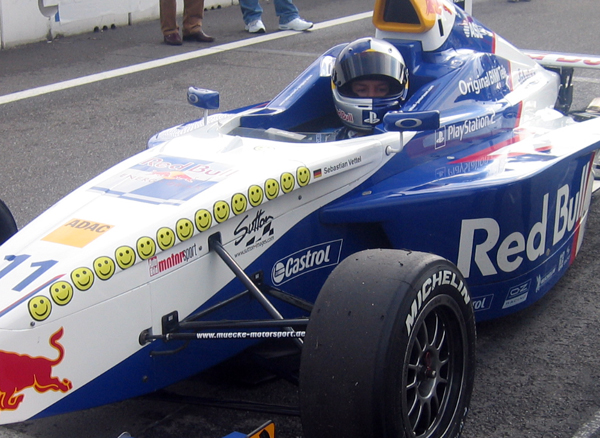
Although Sebastian’s car had the colour scheme and graphic design that indicated that he was in fact, supported financially by BMW, there was also an elephant at the ’ring.

The largest branding on Vettel’s car was not BMW – it was Red Bull.

The smiley faces indicated race wins – he ran out of space. The “Red Bull” represented the elephant.


Who owned the rights to Vettel? Red Bull also had a global driver development program.

How is this gonna play out?

In 2007, Sebastian was named as the test driver for BMW’s Formula 1 team. Was this our answer? He stepped in for the injured Robert Kubica at the Indy GP – drove brilliantly into the points – and then abruptly in July, he was ‘released’ by BMW and replaced Scott Speed at Red Bull’s Toro Rosso.

Why would a German automobile manufacturer racing in Formula 1 release a German superstar race car driver? Methinks that they had no choice and that the wide-awake, energetic elephant had first dibs.

And the rest is history.

Did the loss of Vettel from BMW’s stable have anything to do with BMW leaving Formula 1? Was the global economy a convenient excuse to cover for the “one” that got away? I don’t think we’ll ever know for sure. I do know that public statements and press releases are rarely designed to tell us what really happened.

Maybe Dr. Thiessen will write a book one day.  If he does, I doubt that there will be an elephant, or a bull, on the cover.

Question or comment? – add it here… or email me at jb@brandrenaline.com